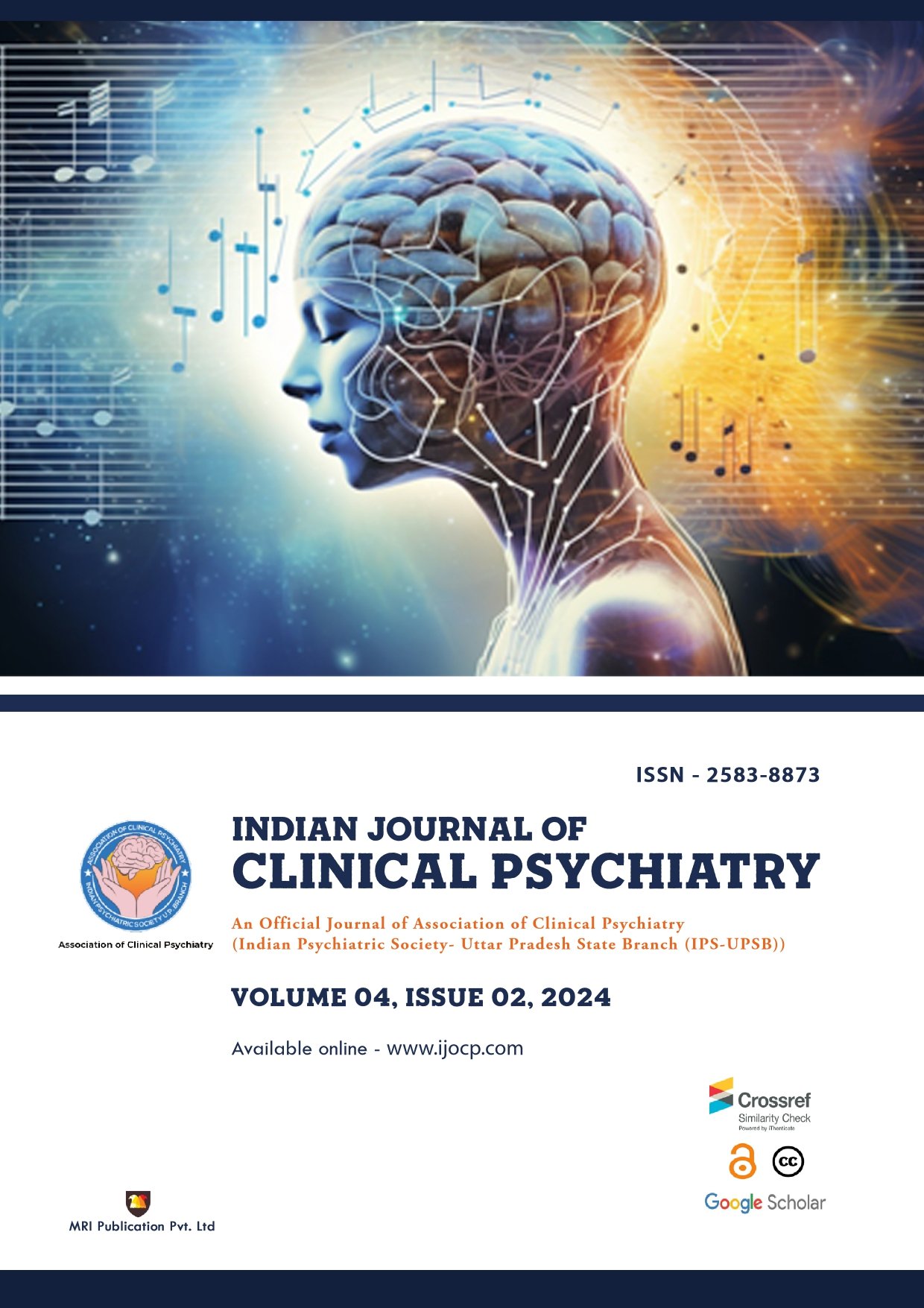
Innovations in Brain Function: How Modern Science Is Redefining Human Thinking: Bridging Neuroscience and Psychology to Transform Human Cognition
Downloads
Published
DOI:
https://doi.org/10.54169/ijocp.v5i02.11Keywords:
: Brain Function, Neurostimulation, Cognitive Therapy, Neuropharmacology, Artificial Intelligence, Human ThinkingDimensions Badge
Issue
Section
License
Copyright (c) 2025 Rehan Naqvi

This work is licensed under a Creative Commons Attribution-NonCommercial-NoDerivatives 4.0 International License.
Recent advances in neuroscience and psychology have transformed our understanding of how the brain shapes thought, emotion, and behavior. Innovations such as neurostimulation, cognitive-behavioral interventions, neuropharmacology, and artificial intelligence (AI) have opened new frontiers in modifying brain function and redefining human thinking. This paper explores how these scientific and psychological approaches interact to enhance cognitive flexibility, emotional regulation, and problem-solving. By integrating neurobiological research with psychological frameworks, a more holistic understanding of human thinking emerges. The results demonstrate that interdisciplinary innovations are reshaping not only the science of cognition but also the philosophy of human thought itself.Abstract
How to Cite
Downloads
1] Kolb B, Gibb R. Brain plasticity and behavior. Annu Rev Psychol. 2019;70:141-164. [2] Thibault RT, Lifshitz M, Raz A. The self-regulating brain and neurofeedback: Experimental science and clinical promise. Cortex. 2018;109:93–118. [3] Lefaucheur JP et al. Evidence-based guidelines on the therapeutic use of repetitive transcranial magnetic stimulation. Clin Neurophysiol. 2020;131(2):474–528. [4] Tang YY, Hölzel BK, Posner MI. The neuroscience of mindfulness meditation. Nat Rev Neurosci. 2015;16(4):213–225. [5] Beck JS. Cognitive behavior therapy: Basics and beyond. 3rd ed. New York: Guilford Press; 2020. [6] Volkow ND, Morales M. The brain on drugs: From reward to addiction. Cell. 2015;162(4):712–725. [7] Hassabis D, Kumaran D, Summerfield C, Botvinick M. Neuroscience-inspired artificial intelligence. Neuron. 2017;95(2):245–258. [8] Pascual-Leone A, Freitas C, Oberman L. Characterizing neuroplasticity in humans: From brain stimulation to cognition. Brain Topogr. 2019;32(6):1011–1024. [9] Friston KJ. The free-energy principle: A unified brain theory? Nat Rev Neurosci. 2010;11(2):127–138.
References
Most read articles by the same author(s)
- Rehan Naqvi, Zameer Ahmed, Geetha Kumari Das, Body Image and “Sexy” in India , Indian Journal of Clinical Psychiatry: Vol. 5 No. 02 (2025): Indian Journal of Clinical Psychiatry
Similar Articles
- Chittaranjan Andrade, A Potential Role for Statins in the Long-term Reduction in the Risk of Neurodegenerative Disease , Indian Journal of Clinical Psychiatry: Vol. 2 No. 02 (2022): Indian Journal of Clinical Psychiatry
- Dr Vivek Kumar, Dr. Asish Kumar , Prof (Dr) Vipul Singh , Mental Health Issues in Menopause , Indian Journal of Clinical Psychiatry: Vol. 3 No. 01 (2023): Indian Journal of Clinical Psychiatry
- Rahul Mathur, Abhishek Chakladar, Anuranjan Vishwakarma, Jawahar Singh, Corpus Callosum Agenesis in a Child with Attention Deficit Hyperactivity Disorder with Prenatal Exposure to Sodium Valproate: A Case Report , Indian Journal of Clinical Psychiatry: Vol. 3 No. 01 (2023): Indian Journal of Clinical Psychiatry
- A.K. Agarwal, Religion and Mental Health , Indian Journal of Clinical Psychiatry: Vol. 3 No. 01 (2023): Indian Journal of Clinical Psychiatry
- Afzal Javed, Nazish Imran, Schools: A vital component of Child and Adolescent Mental Health , Indian Journal of Clinical Psychiatry: Vol. 3 No. 01 (2023): Indian Journal of Clinical Psychiatry
- Aleena Thomas, Mohammad Ahsan, Rashmi Shukla, Ashutosh Mishra, Arghya Pal, Abrupt Onset Depressive Episode in Patient with Lenticular Nucleus Infarct with Low-Risk Factors , Indian Journal of Clinical Psychiatry: Vol. 3 No. 02 (2023): Indian Journal of Clinical Psychiatry
- Gayatri Bhatia, Yoseph Kale, Frog sweat misuse – emerging evidence from India , Indian Journal of Clinical Psychiatry: Vol. 4 No. 01 (2024): Indian Journal of Clinical Psychiatry
- Abhishek Mohanty, Vivek P Vajaratkar, Amit Dias, Prevalence of Body Dysmorphic Disorder in College- Going Students: A Quantitative Study , Indian Journal of Clinical Psychiatry: Vol. 4 No. 01 (2024): Indian Journal of Clinical Psychiatry
- Aditi Jain, Abbas Mehdi, Evaluation of Language Dysfunction among Untreated Patients with Psychosis Attending the Psychiatry Inpatient Services of a Tertiary Healthcare Centre from North India: A Cross-sectional Study , Indian Journal of Clinical Psychiatry: Vol. 4 No. 01 (2024): Indian Journal of Clinical Psychiatry
- Uttam Chandra Garg, Whispering Machines: Potential Mental Health Risks of AI Chatbots , Indian Journal of Clinical Psychiatry: Vol. 6 No. 01 (2026): Indian Journal of Clinical Psychiatry
You may also start an advanced similarity search for this article.